

Metabolic Research
This page maps a research category by mechanism and evidence tier. It is not a ranking, a recommendation, a dosing reference, or medical advice.
Anchors: Retatrutide, Tirzepatide, Semaglutide, 5-Amino-1MQ, SLU-PP-332, Survodutide
About This Research Area
What This Research Category Covers
Metabolic Research brings together research examining Retatrutide, Tirzepatide, Semaglutide, 5-Amino-1MQ, SLU-PP-332, Survodutide, including underlying mechanisms, experimental models, investigational compounds, and an evolving evidence base.
Legend Research organizes this material around the scientific questions being investigated — not claimed outcomes. The presence of a compound, pathway, or study in this library does not imply established efficacy, safety, clinical utility, or regulatory approval.
Research scope: educational and informational only. Legend Research does not provide medical, dosing, administration, or clinical guidance.
Explore the Field
The Metabolic Research Landscape
Start with the system, then follow the evidence. A research compound rarely exists in isolation — its significance depends on the pathway it interacts with, the question researchers are asking, the experimental model being used, and the strength of the resulting evidence.
Metabolic & Energy Biology
From Discovery to Investigation
How Research Reaches This Field
Biological Observation
Research often begins with an observation: a naturally occurring molecule, biological process, unusual phenotype, signaling pathway, or unexplained experimental effect.
Mechanism Identified
Researchers investigate the receptors, enzymes, genes, signaling pathways, or cellular processes that may explain the observation.
Experimental Target
A biological mechanism becomes a research target. Scientists begin asking whether manipulating that system can reveal more about its function.
Investigational Molecules
Natural molecules, analogues, peptides, small molecules, antibodies, or other experimental tools may be developed or studied to probe the target.
Preclinical Evidence
Cellular and animal models test increasingly specific hypotheses about mechanism, biological activity, pharmacology, or other research questions.
Human Investigation
Some research programs eventually reach human observational or interventional studies. Many do not—and results from earlier models cannot automatically be assumed to translate to humans.
Replication & Refinement
Evidence evolves through replication, conflicting findings, improved methods, larger datasets, and new experiments.
Scientific evidence is a lineage, not a finish line.
Guides

Tirzepatide: Craving ≠ Hunger
Why craving and hunger are different signals that tirzepatide research shouldn't compress into one
1 min

Retatrutide: “Food Noise”
Why “food noise” isn't one biological measurement, and what retatrutide research still needs to define
1 min
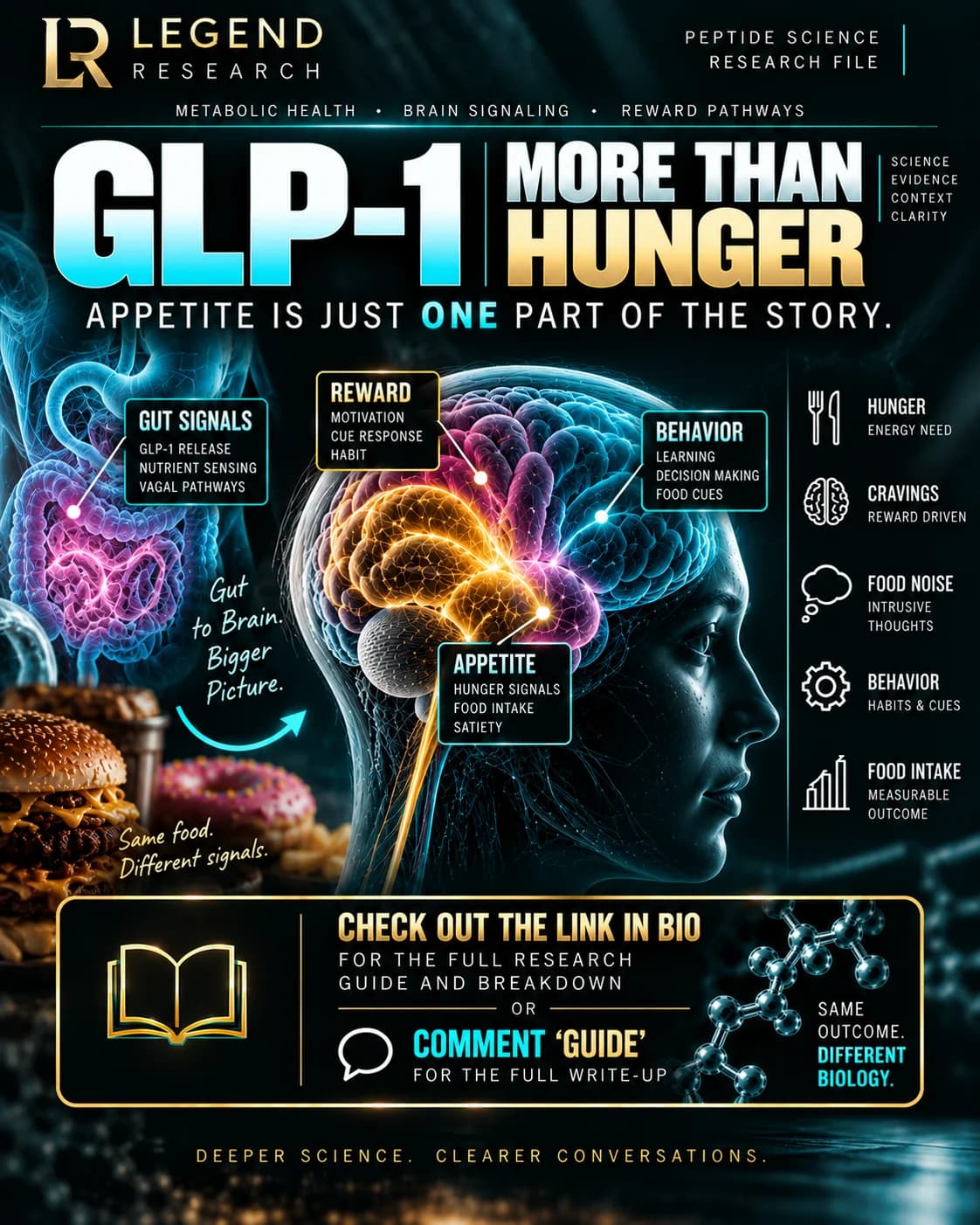
GLP-1: More Than Hunger
Why GLP-1 research spans hunger, satiety, cravings, and food cues, not appetite alone
1 min

MOTS-c & Longevity: Mitochondria Aren’t Just Cell Batteries
What preclinical MOTS-c research says about mitochondria, metabolism, and the limits of calling anything an anti-aging switch
1 min
GLP Receptor Agonists and Opioid Craving: What a Small, Messy Pilot Trial Actually Showed
A small Penn State pilot trial found liraglutide reduced opioid craving by 40% versus placebo, but only 9 of 20 randomized patients completed it — a much larger outpatient trial is now underway.
4 min
Ozempic vs. Retatrutide: One Signal vs. Three Pathways
Semaglutide amplifies a single GLP-1 signal; retatrutide coordinates three receptor pathways at once — but the two compounds have never been tested head-to-head in the same trial.
4 min
GLP and Nicotine: The 46% vs. 27% Signal, and Its Contradiction
A pilot trial found exenatide roughly doubled smoking-abstinence rates versus placebo, but a separate trial testing dulaglutide for the same purpose found no effect at all.
3 min
Retatrutide in 2026: Inside the Weight-Loss Industry’s Next Bet
Retatrutide's TRIUMPH trial program has posted the largest weight-loss numbers ever recorded in a Phase 3 obesity trial, while remaining unapproved anywhere in the world.
5 min
Retatrutide’s Three Receptor Pathways, Explained
GLP-1, GIP, and glucagon each play a distinct role in retatrutide's triple-agonist design — including the historically avoided glucagon pathway.
4 min
MOTS-c and Cancer Biology: Early Signals & Emerging Research — But Not Yet Answers
MOTS-c slowed ovarian cancer cell growth in lab and animal models, but a separate adrenal-tumor study found a more complicated, tissue-dependent pattern — this is early preclinical work, not a treatment finding.
4 min
Tesamorelin Targets a Different Fat Depot: The Visceral-Fat Research
Because visceral fat carries a higher density of growth hormone receptors than subcutaneous fat, tesamorelin selectively reduces visceral fat by 15.4% versus placebo with no significant change to subcutaneous fat.
3 min
GLP and Alcohol Craving: Three Trials, One Unresolved Question
Three trials testing GLP receptor agonists for alcohol use disorder disagree with each other — exenatide's brain-imaging signal didn't translate to drinking outcomes, while semaglutide's did.
3 min
Legend Research Evidence Standard
Six Tenets for Reading the Evidence
Start With the Research Question
A study is evidence for the question it actually investigated—not every broader claim that could be associated with its subject.
Identify the Model
Cells, isolated tissues, animals, observational human data, and controlled human studies are not interchangeable. The model determines what conclusions the experiment can reasonably support.
Separate Mechanism From Outcome
Showing that a molecule interacts with a receptor or signaling pathway establishes something different from demonstrating a downstream biological outcome. Mechanistic plausibility is evidence—not proof of every proposed effect.
Read the Method, Not Just the Result
Sample size, controls, endpoints, analytical techniques, experimental conditions, statistical methods, and study duration can materially change how a result should be interpreted. A headline number without methodology is incomplete evidence.
Look for Replication
One striking experiment can generate a hypothesis. Confidence becomes stronger when findings survive independent replication, different models, different laboratories, and stronger study designs.
Keep the Conclusion Inside the Evidence
Animal findings should remain animal findings. Associations should remain associations. Preclinical mechanisms should remain preclinical mechanisms. Early human findings should not automatically become established clinical conclusions.
The strength of a scientific claim should never exceed the strength of the evidence supporting it.
Research Questions
Frequently Asked Questions
What is included in Metabolic Research?+
This library covers the foundational biology, signaling pathways, experimental models, investigational compounds, analytical methods, and published evidence relevant to this category. Coverage expands as new research files and reference materials are added.
How does Legend Research choose which compounds to cover?+
Coverage is driven by scientific relevance, available literature, research interest, and the compound's relationship to the biological systems explored within the library. Inclusion does not represent an endorsement of a compound or its use.
What is the difference between preclinical and human research?+
Preclinical research generally includes laboratory and animal models used to investigate mechanisms, biological activity, and experimental hypotheses before or outside human investigation. Human research directly involves human participants or human-derived data. Results from one evidence level should not automatically be assumed to apply to another.
Does a promising animal study mean the same effect occurs in humans?+
No. Animal models can provide valuable mechanistic and experimental evidence, but biological differences between species can affect whether findings translate to humans. Human-specific conclusions require appropriate human evidence.
Why does Legend Research discuss investigational compounds?+
Investigational compounds can be useful tools for understanding biological systems and represent active areas of scientific inquiry. Legend Research covers them to document what researchers are investigating, how the research developed, and what the available evidence does and does not establish.
How should I interpret conflicting studies?+
Conflicting results are a normal part of scientific research. Differences in experimental model, dose or exposure conditions, methodology, sample size, endpoints, population, statistical analysis, and study design can produce different findings. Rather than selecting the most dramatic result, examine the totality, consistency, and quality of the evidence.
Does inclusion in the Research Library mean a compound is proven safe or effective?+
No. Inclusion means the subject has educational or scientific relevance to the library. It does not establish safety, efficacy, clinical utility, regulatory approval, or suitability for human use.
Dispatch — Research Updates
Opting in means a real person from our team may reach out regarding your research inquiry.