
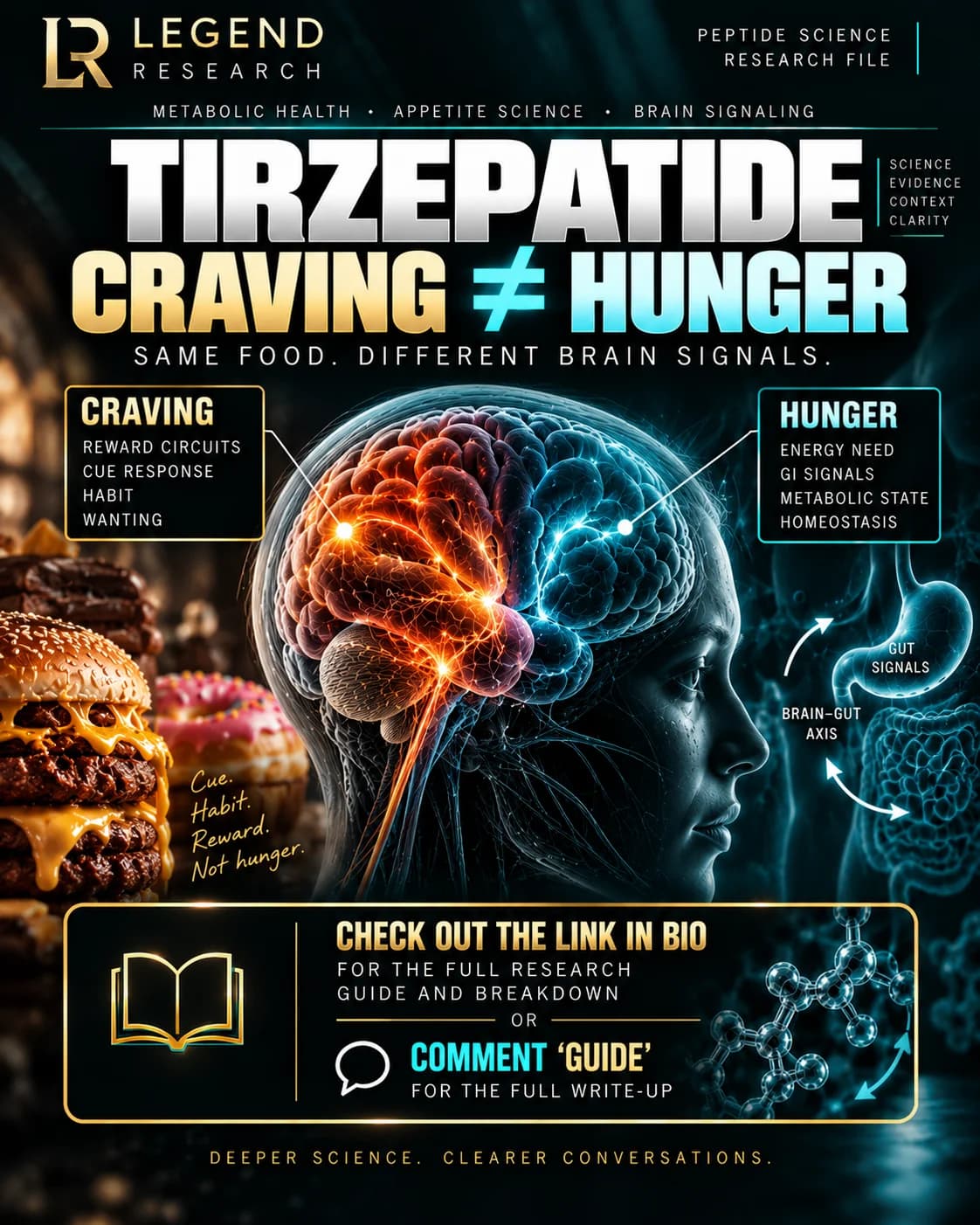
Tirzepatide: Craving ≠ Hunger
1 min
You can want a cheeseburger when you’re hungry. You can also want one twenty minutes after dinner.
Same food. Very different starting point.
This distinction gets lost when discussions around tirzepatide compress everything into “appetite suppression.”
Hunger is closely connected to homeostatic regulation. The brain integrates information about energy state, gastrointestinal signals, nutrients, hormones, and other inputs.
A craving can appear without an immediate energy deficit. A smell, habit, memory, advertisement, or learned association can make a particular food suddenly feel important. This involves another layer of eating behavior: reward and motivation. [2]
Tirzepatide activates both GIP and GLP-1 receptors, making its biology more complicated than a simple hunger switch. [1]
If someone eats less, that outcome alone cannot tell us whether hunger decreased, satiety increased, cravings changed, food cues became less motivating, or several processes changed together.
That is why research endpoints matter. A hunger questionnaire, craving scale, actual food intake measurement, and behavioral cue experiment answer different questions.
So don’t only ask “Did subjects eat less?”
Ask:
“What part of the eating-behavior system changed?”
Craving and hunger can lead to the same behavior without being the same signal.
Legend Research Note
Tirzepatide has established clinical indications, but specific mechanistic and behavioral claims should be interpreted according to what individual studies actually measured. [3]
Explore the Legend Research Library for deeper metabolic and GLP-1 research.
Further Reading
- Tirzepatide is an imbalanced and biased dual GIP and GLP-1 receptor agonist — Willard et al., JCI Insight 2020 — core pharmacology paper on tirzepatide’s dual mechanism.
- MOUNJARO (tirzepatide) FDA Prescribing Information — Official FDA label confirming the GIP/GLP-1 dual-agonist mechanism and approved indications.
- Neural integration of satiation and food reward: role of GLP-1 and orexin pathways — Dickson et al., Physiology & Behavior 2014 — distinguishes hunger/satiation circuitry from reward-driven eating.
Continue the Research
For tirzepatide’s mechanism, identity, and the documented state of the evidence, see Tirzepatide in the Registry. And since eating-behavior endpoints are only as trustworthy as the material studied, 99% Pure. But 99% of What? and Standards & Industry cover how that verification actually works.
Dispatch — Research Updates
Opting in means a real person from our team may reach out regarding your research inquiry.