
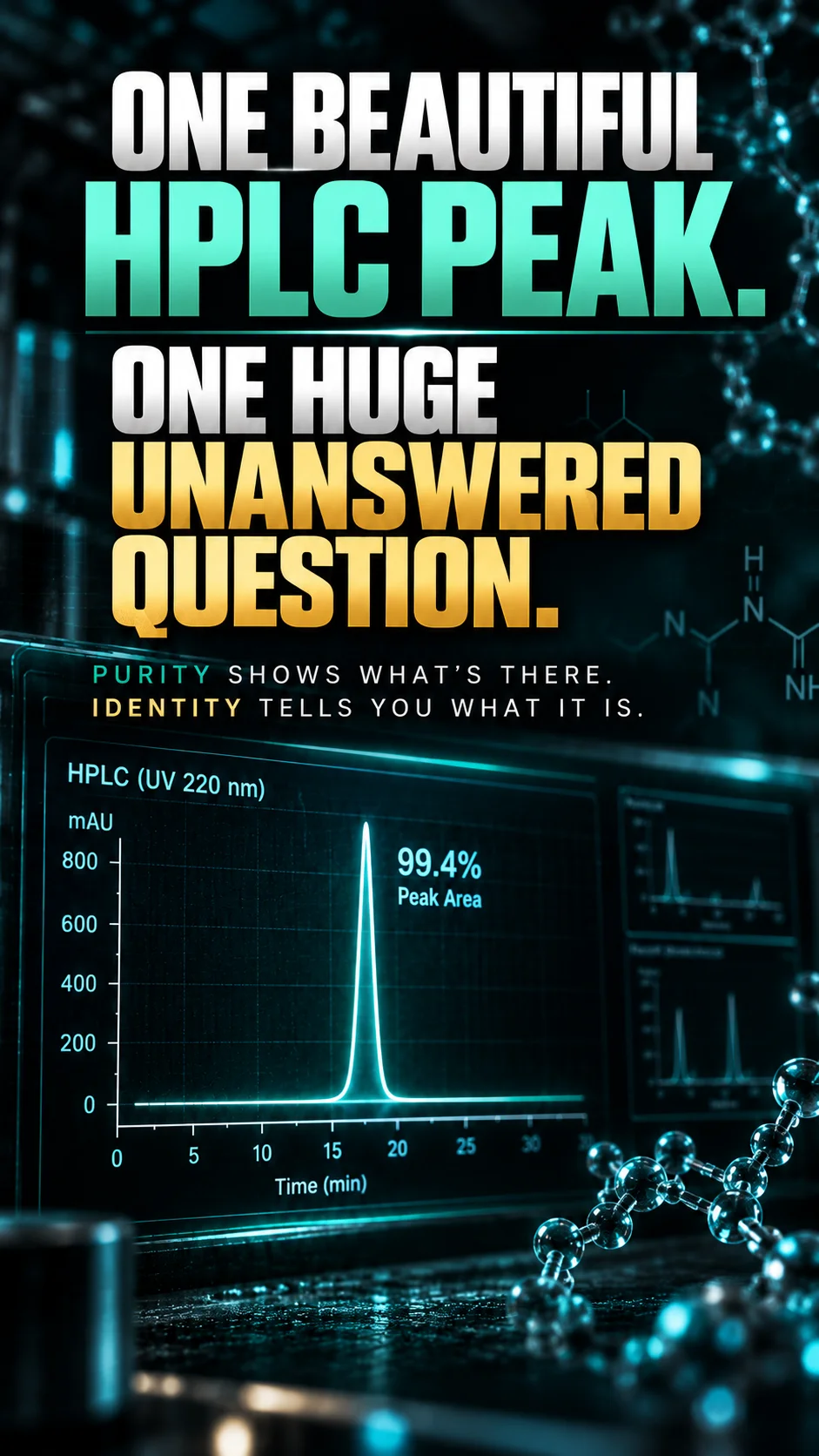
99% PURE. BUT 99% OF WHAT?
1 min
A certificate of analysis says: PURITY: 99.4%
It looks precise. But before deciding what that number means, there is a more important question:
99.4% of what?
This is where purity and identity get confused.
In peptide analysis, chromatography methods such as HPLC can separate components of a sample. A chromatogram displays those components as peaks, and under a particular analytical method, peak-area measurements can help characterize the relative composition of detected material.
If one dominant peak accounts for roughly 99% of the relevant detected peak area, that can support a high chromatographic-purity result.
But:
A purity result and an identity result are not the same measurement.
A sample might show one dominant chromatographic component, but you still need evidence supporting what that component actually is.
That is where complementary analytical methods matter. Mass spectrometry, for example, can provide molecular-mass information that helps support compound identity.
Simplified:
Chromatography: What does the sample’s composition look like under this method?
Mass spectrometry: Does the detected molecular information support the expected identity?
And those tests still don’t answer everything. Purity doesn’t automatically establish sterility. Identity doesn’t establish endotoxin status. A chromatogram doesn’t establish net content.
A COA is more useful when you read it as a collection of specific analytical claims supported by specific methods, not one final grade.
So when you see “99% PURE,” ask:
“99% of what, measured how, and what evidence supports the identity?”
Purity is a measurement.
Verification is a process.
Legend Research Note
Analytical methods answer specific questions and have method-dependent limitations. No single purity percentage should be interpreted as complete verification of identity, sterility, endotoxin status, quantity, or every other quality attribute.
Explore the Legend Research Library for the full COA and analytical-verification guide.
Continue the Research
Apply this to any specific compound by starting at the Registry, where each entry documents its own mechanism and state of the evidence. For the full set of testing and verification standards referenced above, see Standards & Industry.
Dispatch — Research Updates
Opting in means a real person from our team may reach out regarding your research inquiry.