
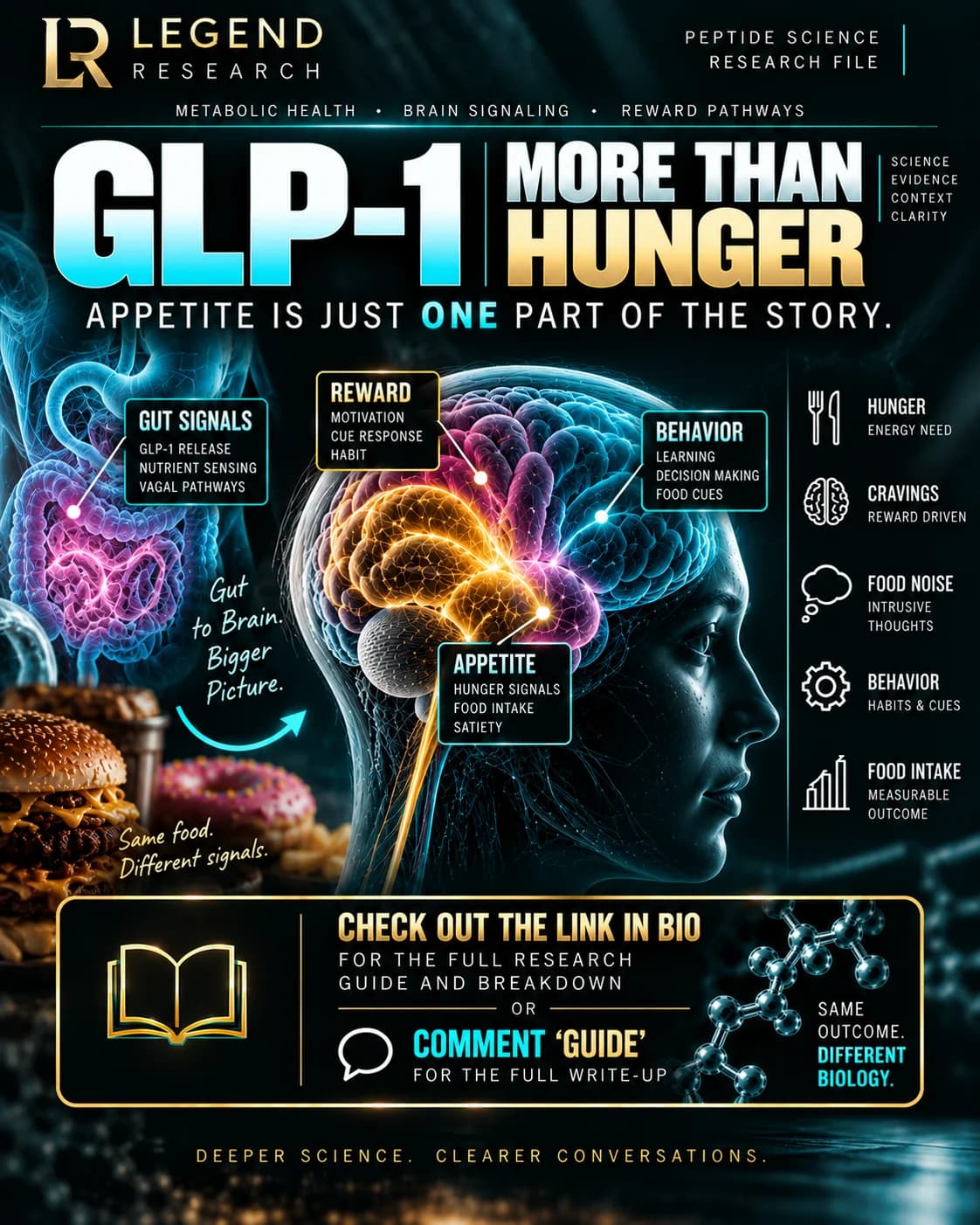
GLP-1: More Than Hunger
1 min
GLP-1 drugs are often explained with one sentence: they make you less hungry. That’s part of the story, but not the whole story.
GLP-1 is a signaling hormone involved in glucose regulation, gastrointestinal function, and communication between the gut and brain. [1] Its receptors are found in multiple tissues, including nervous-system regions involved in eating behavior. [2]
That matters because eating isn’t controlled by one signal called appetite.
You can be hungry because you haven’t eaten. You can want dessert immediately after dinner. Or you can keep thinking about food without feeling physically hungry. All three can lead to eating, but they aren’t necessarily the same experience.
Hunger is strongly connected to systems regulating energy availability. Cravings can involve reward, learned associations, sensory cues, and motivation. [3] “Food noise” is popular language for persistent food-related thoughts, but it isn’t one single, universally standardized biological signal.
These systems can overlap. They can also come apart.
That helps explain why GLP-1 research can examine food intake, satiety, cravings, food-cue responses, reward-related behavior, and other endpoints. If food intake decreases, that alone doesn’t tell us exactly why.
So when a study reports a change in appetite-related behavior, ask:
What did researchers actually measure? Hunger? Satiety? Cravings? Food intake? Cue response? Reward-related behavior?
The answer tells you much more than the word “appetite.”
Legend Research Note
GLP-1 biology spans metabolic, gastrointestinal, and central nervous-system pathways. Effects and approved uses vary by specific medication and should not be generalized from one compound or endpoint to another.
Explore the Legend Research Library for deeper metabolic research.
Further Reading
- Brain GLP-1 and the regulation of food intake — Trapp & Brierley, British Journal of Pharmacology 2022 — review of central GLP-1 receptor action beyond the gut.
- GLP-1 physiology and pharmacology along the gut-brain axis — Beutler, Journal of Clinical Investigation 2026 — current review of GLP-1 signaling across the gut-brain axis.
- Lateral hypothalamus, nucleus accumbens, and ventral pallidum roles in eating and hunger — Review distinguishing homeostatic hunger circuitry from reward circuitry.
Continue the Research
The two GLP-1-pathway compounds currently documented in the Library — Tirzepatide and Retatrutide — break down mechanism and evidence for each specific molecule rather than the drug class as a whole. And because endpoint claims are only meaningful alongside verified material, 99% Pure. But 99% of What? and Standards & Industry cover how purity and identity are actually confirmed.
Dispatch — Research Updates
Opting in means a real person from our team may reach out regarding your research inquiry.