
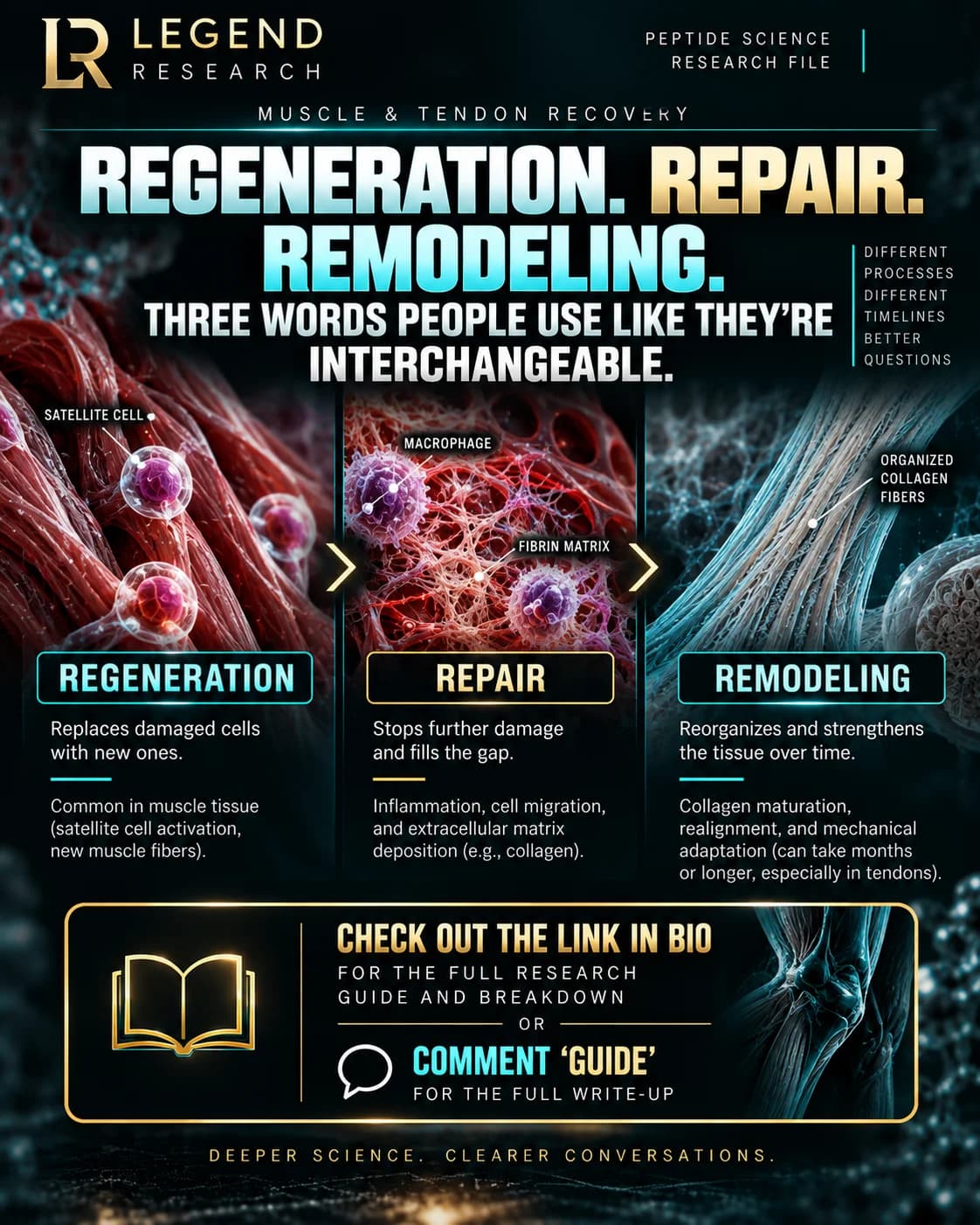
Regeneration. Repair. Remodeling.
1 min
In recovery research, three words get used as though they mean the same thing: regeneration, repair, and remodeling.
They don’t.
The difference matters when compounds such as BPC-157 are discussed under broad labels like “tissue healing.”
Regeneration refers to replacing damaged cells or tissue in a way that restores functional tissue.
Repair is broader. After damage, the body needs to control the damaged environment, clear debris, recruit cells, produce extracellular matrix, and stabilize the area.
Then comes remodeling. New tissue isn’t necessarily finished tissue. Collagen deposited during repair can continue to reorganize and mature, while mechanical properties can change over time. [2]
This is especially important in tendon research. Tendon is a dense, collagen-rich structure designed to transmit force. [1] Producing more collagen doesn’t automatically mean the original tendon architecture or mechanical properties have been restored.
So if a study reports increased collagen deposition, did the tissue regenerate? Did repair accelerate? Did remodeling improve? Did mechanical strength change?
Those are different claims.
A change in inflammation, vascular response, collagen, histology, or mechanical properties tells us something specific. It should not automatically become “the tissue healed faster.”
Instead, ask:
Which phase changed, and what endpoint demonstrated it?
Legend Research Note
Evidence involving BPC-157 is predominantly preclinical. [3] Findings from animal or cellular injury models should not be interpreted as established human therapeutic outcomes.
Explore the Legend Research Library for the full muscle and tendon research series.
Further Reading
- Tendon healing: an overview of physiology, biology, and pathology of tendon healing — Docheva et al., Knee Surg Sports Traumatol Arthrosc 2015 — standard review of the three-phase tendon healing model.
- Biology of tendon injury: healing, modeling and remodeling — Sharma & Maffulli, J Musculoskelet Neuronal Interact 2006 — describes collagen reorganization and remodeling timeline.
- The promoting effect of pentadecapeptide BPC 157 on tendon healing involves tendon outgrowth, cell survival, and cell migration — Krivic et al., Journal of Applied Physiology 2011 — primary BPC-157 rat/explant tendon study, cellular/histological endpoints only.
Continue the Research
BPC-157’s registry entry lays out its documented mechanism and the state of the evidence behind the tissue-repair research discussed above — see BPC-157 in the Registry. And because phase-specific claims like these depend on knowing what was actually in the study material, 99% Pure. But 99% of What? and Standards & Industry cover how purity and identity are verified.
Dispatch — Research Updates
Opting in means a real person from our team may reach out regarding your research inquiry.