
Why Does BPC-157 Research Keep Bringing Up Blood Vessels?
1 min
If you spend enough time reading BPC-157 research, one concept keeps appearing: blood vessels.
Why would vascular biology matter in tissue repair? Because injured tissue doesn’t rebuild in isolation. Cells need oxygen and nutrients, signaling molecules move through the tissue environment, immune cells participate in the response, and extracellular matrix has to be produced and reorganized.
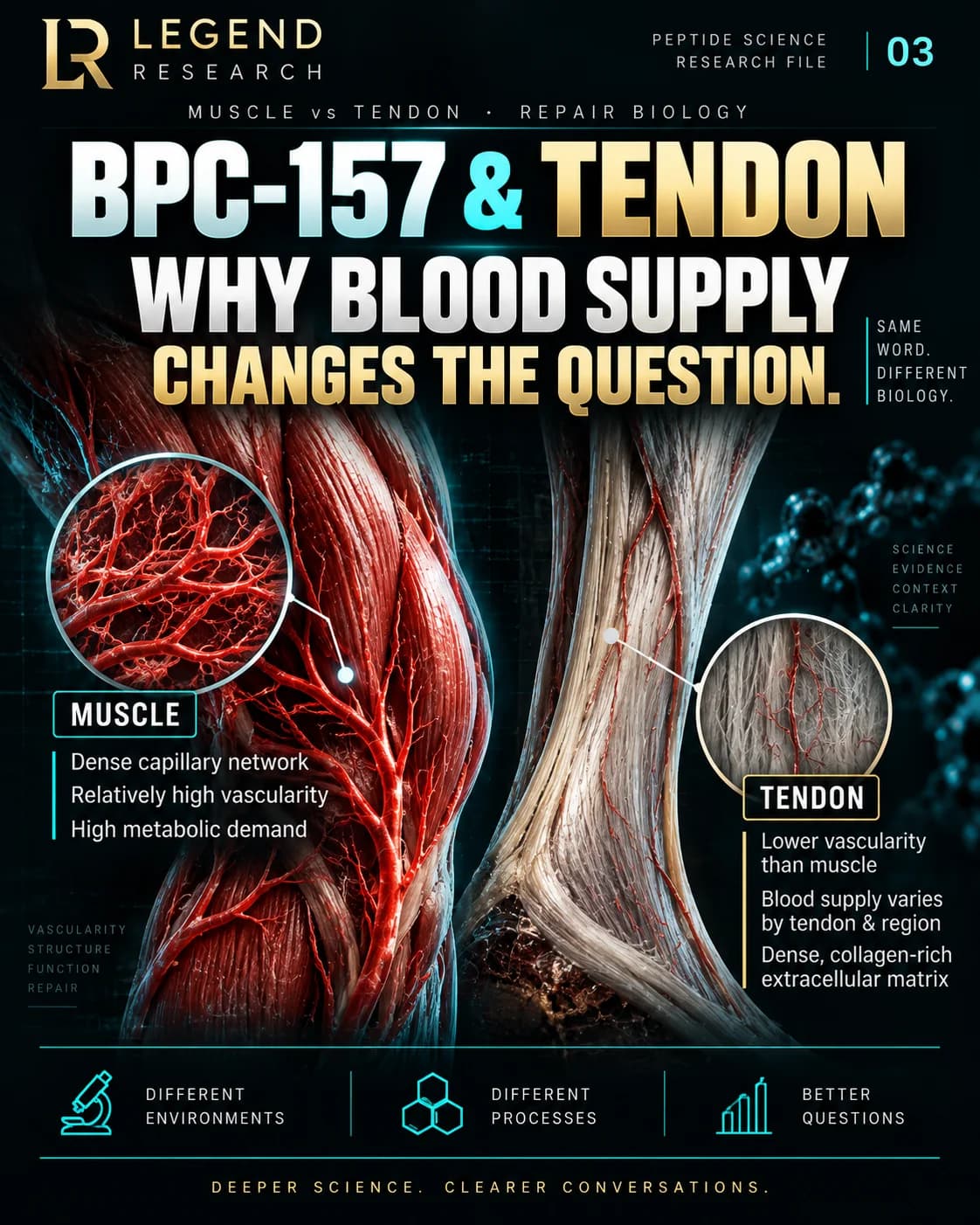
But muscle and tendon provide different environments.
Skeletal muscle is richly vascularized, with a dense capillary network supporting its metabolic demands.
Tendons have blood vessels too, but their vascularity is generally lower than skeletal muscle and can vary between tendons and even between regions of the same tendon. Tendon is also dominated by dense, organized collagen-rich extracellular matrix.
This is one reason angiogenesis, the formation and remodeling of blood vessels, appears in parts of the experimental BPC-157 literature. [1]
But:
More blood vessels ≠ automatically better healing.
A vascular response is one component of a larger repair process. [2] Researchers still need to determine what happened to tissue organization, collagen architecture, mechanical properties, and other functional endpoints.
And because much of the BPC-157 literature comes from animal and laboratory models, observed vascular effects cannot simply be translated into established human recovery outcomes. [3]
The better question is:
“How did vascular signaling change in the experimental model, and what happened to the tissue alongside it?”
Legend Research Note
BPC-157 remains supported primarily by preclinical research. Mechanistic findings involving vascular signaling or experimental tissue repair should not be interpreted as established human therapeutic effects.
Explore the Legend Research Library for deeper tissue-repair research.
Further Reading
- The promoting effect of pentadecapeptide BPC 157 on tendon healing involves tendon outgrowth, cell survival, and cell migration — Krivic et al., Journal of Applied Physiology 2011 — rat/explant model touching on vascular-adjacent tendon repair.
- Multifunctionality and Possible Medical Application of the BPC 157 Peptide — Literature and Patent Review — Broad review of BPC-157 preclinical mechanisms, including angiogenesis.
- Emerging Use of BPC-157 in Orthopaedic Sports Medicine: A Systematic Review — Vasireddi et al., HSS Journal 2025 — confirms evidence is low-level/preclinical with minimal human safety data.
Continue the Research
See BPC-157 in the Registry for the full mechanism writeup and documented state of the evidence behind the vascular findings discussed above. And because preclinical mechanistic claims are only as sound as the material tested, 99% Pure. But 99% of What? and Standards & Industry cover how purity and identity are actually verified.
Dispatch — Research Updates
Opting in means a real person from our team may reach out regarding your research inquiry.