
There May Be No Single Aging Switch
3 min
Longevity research often gets reduced to one big idea. NAD+ declines with age. Senescent cells accumulate. Mitochondria change. Epigenetic clocks move. Each discovery can quickly become its own version of the same headline: scientists may have found the aging switch.
But aging may not work like a single switch at all.
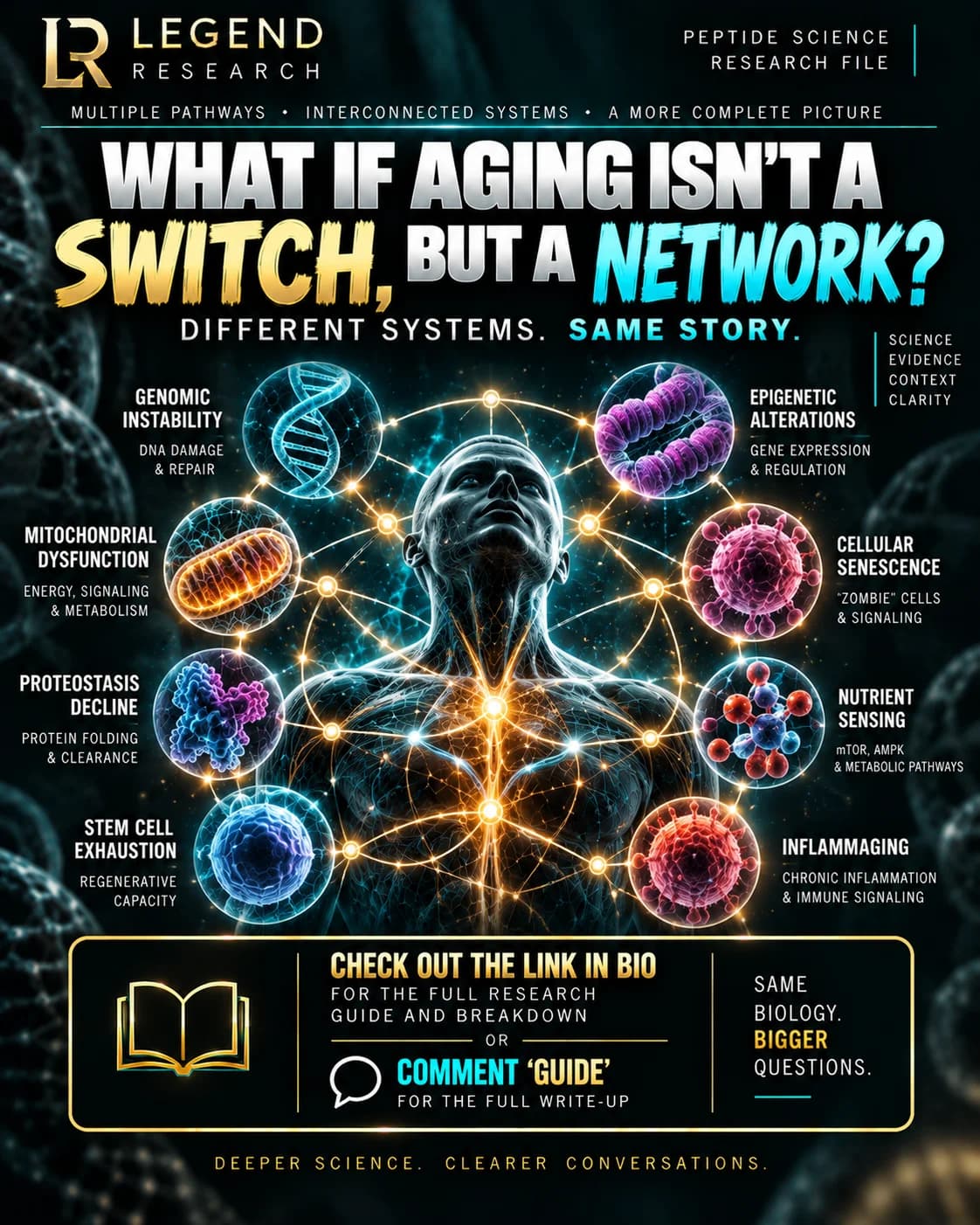
A better model is a network of interacting biological systems. Researchers study changes in DNA stability, epigenetic regulation, mitochondrial function, protein quality control, nutrient sensing, cellular senescence, inflammation, regenerative capacity, and communication between cells. [1]
These systems do not operate independently. Mitochondrial dysfunction can alter metabolism and cellular signaling. DNA damage can influence stress responses and senescence. Senescent cells can change the environment around them. Changes in nutrient sensing can affect growth, metabolism, autophagy, and cellular maintenance. [2]
That leads to an important distinction:
A mechanism involved in aging is not necessarily THE mechanism of aging.
Take NAD+. It plays important roles in metabolism and cellular regulation, and NAD+ biology can change with age. That makes it valuable to study. But changing NAD+ does not automatically correct every other age-associated process.
The same applies to senescent cells. Their accumulation is an important area of longevity research, but removing certain senescent cells does not mean every component of aging has been reversed.
Even biological-age tests have this limitation. An epigenetic clock might estimate that someone moved from a biological age of 47 to 39. That means the molecular patterns used by that particular model changed in a direction it interprets as younger.
But did cardiovascular function improve? Cognition? Immune function? Physical capacity? Disease risk?
Those require additional evidence.
This is why biomarker change and whole-body rejuvenation are not the same claim.
The same problem appears in longevity studies. Researchers might measure lifespan, frailty, physical performance, mitochondrial function, inflammation, methylation patterns, disease outcomes, or cellular behavior. An improvement in one endpoint can be meaningful without proving improvement in all the others.
Aging can also differ across tissues. A neuron, liver cell, muscle fiber, and immune cell have different functions, environments, metabolic demands, and regenerative capacities. One biological-age number may summarize useful information without perfectly describing every tissue in the body.
None of this makes longevity research less promising. It makes the questions better.
Instead of searching only for the molecule that “controls aging,” researchers can ask which systems contribute to particular age-associated changes, how those systems interact, which changes are reversible, and whether changing a biomarker also preserves meaningful function.
So when you see “reversed biological age,” “cleared aging cells,” “restored NAD+,” or “improved mitochondrial function,” don’t assume they all mean the same thing.
Ask:
What changed? How was it measured? In which tissue or model? And did function change with it?
There may be no single aging switch because aging may not be a single process.
It may be a network. [3]
The better question isn’t simply “Does it reverse aging?”
It is:
“What part of aging actually changed?”
Legend Research Note
Longevity findings should be interpreted according to the specific model, tissue, intervention, endpoint, and level of evidence. Changes in individual biomarkers or pathways should not automatically be interpreted as whole-body rejuvenation or proven lifespan extension.
Explore the Legend Research Library for deeper longevity research.
Further Reading
- The Hallmarks of Aging — López-Otín et al., Cell 2013 — the original framework of nine interacting hallmarks of aging.
- Hallmarks of aging: An expanding universe — López-Otín et al., Cell 2023 — 2023 update to 12 hallmarks, more explicit about interconnection.
- New hallmarks of ageing: a 2022 Copenhagen ageing meeting summary — GeroScience 2022 — argues hallmarks have more value viewed as a network than as individual processes.
Continue the Research
If aging is a network rather than a single switch, the more useful habit is checking individual systems on their own terms rather than looking for one master intervention. The Registry documents the individual compounds studied within that network — including the NAD+ and mitochondrial biology raised above — with their evidence and limitations laid out separately, not bundled into one claim. And since biomarker claims are only as good as the testing behind the material studied, 99% Pure. But 99% of What? and the broader Standards & Industry section cover how that verification actually works.
Dispatch — Research Updates
Opting in means a real person from our team may reach out regarding your research inquiry.