
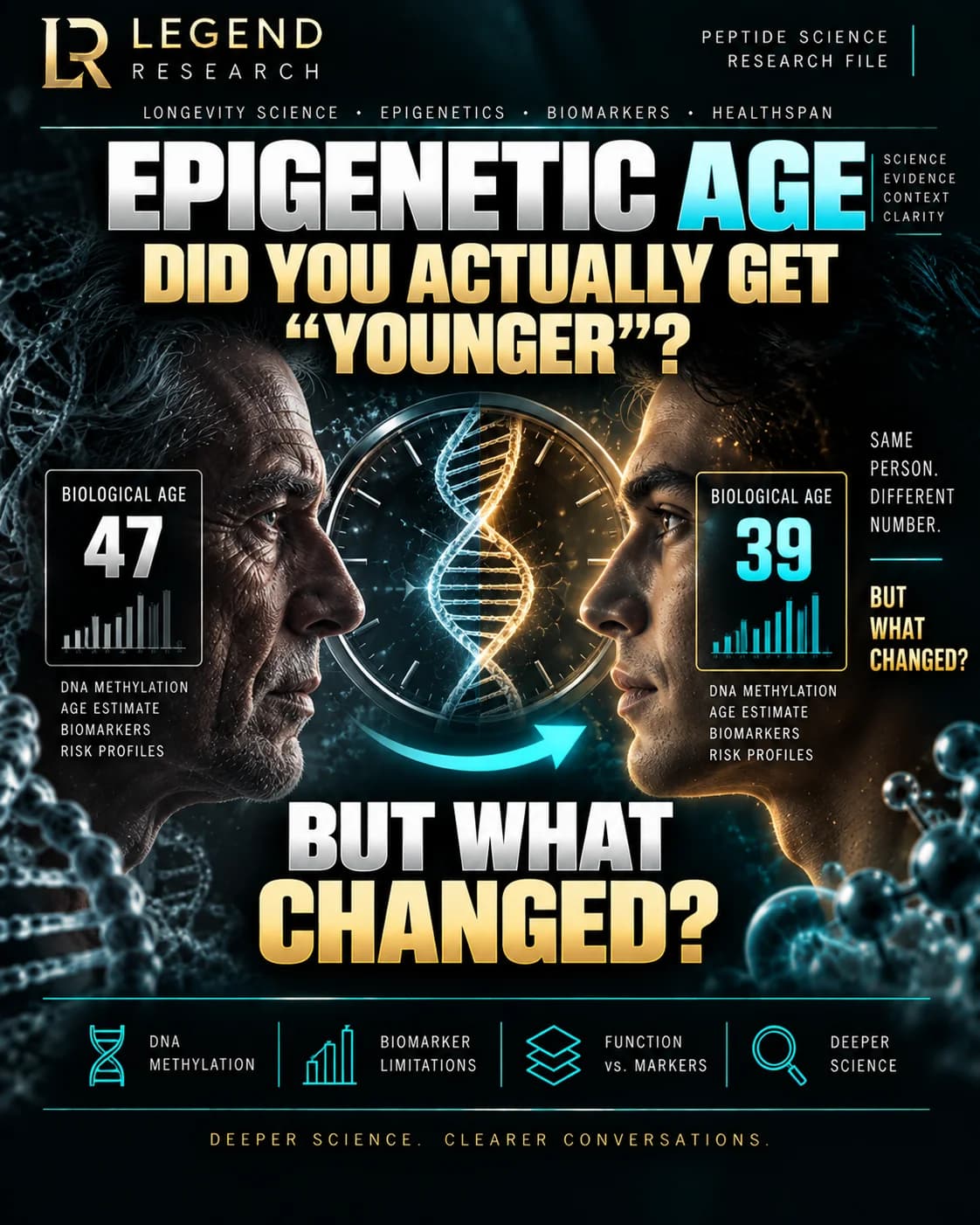
Epigenetic Age: Did You Actually Get “Younger”?
1 min
Imagine taking a biological-age test at 47 and receiving a result of 39. It is tempting to read that as: “My body became eight years younger.”
But that isn’t exactly what the number means.
Many biological-age models use patterns in DNA methylation to build statistical estimates often called epigenetic clocks. [1] These can be powerful research tools, but the result is still an estimate produced by a particular model. [2]
If a score changes from 47 to 39, the safest interpretation is that the biomarkers used by that clock shifted in a direction the model interprets as younger.
That is interesting. It is not automatically proof that every tissue in the body became eight years younger.
Did cardiovascular function improve? Immune function? Cognition? Physical capacity? Disease risk? Those questions require their own measurements.
This creates a crucial distinction:
Biomarker reversal ≠ whole-body rejuvenation. [3]
The problem begins when a measurement tool becomes a conclusion.
So when you see a claim that an intervention “reversed biological age,” ask:
Which clock? What biomarkers changed? Was the result reproduced? And did measurable function improve alongside the score?
A younger number can be scientifically interesting. Understanding what actually became younger is the bigger question.
Legend Research Note
Epigenetic clocks are research and risk-estimation tools, not direct measurements of every component of human aging. Interpret changes according to the specific model and accompanying functional evidence.
Explore the Legend Research Library for the full longevity research series.
Further Reading
- DNA methylation age of human tissues and cell types — Horvath, Genome Biology 2013 — the original multi-tissue epigenetic clock paper.
- Epigenetic Clock: DNA Methylation in Aging — Review describing epigenetic clocks as statistical estimators, not direct measurements.
- DNA methylation-based biomarkers and the epigenetic clock theory of ageing — Fransquet et al., Nature Reviews Genetics 2019 — discusses interpretation limits of clock-based biomarkers.
Continue the Research
A biomarker score is only one input — the compounds studied for the biology underneath it are documented individually in the Registry, with their evidence and limitations kept separate rather than folded into one number. And since any research material is only as reliable as its verification, 99% Pure. But 99% of What? and Standards & Industry cover how that verification actually works.
Dispatch — Research Updates
Opting in means a real person from our team may reach out regarding your research inquiry.